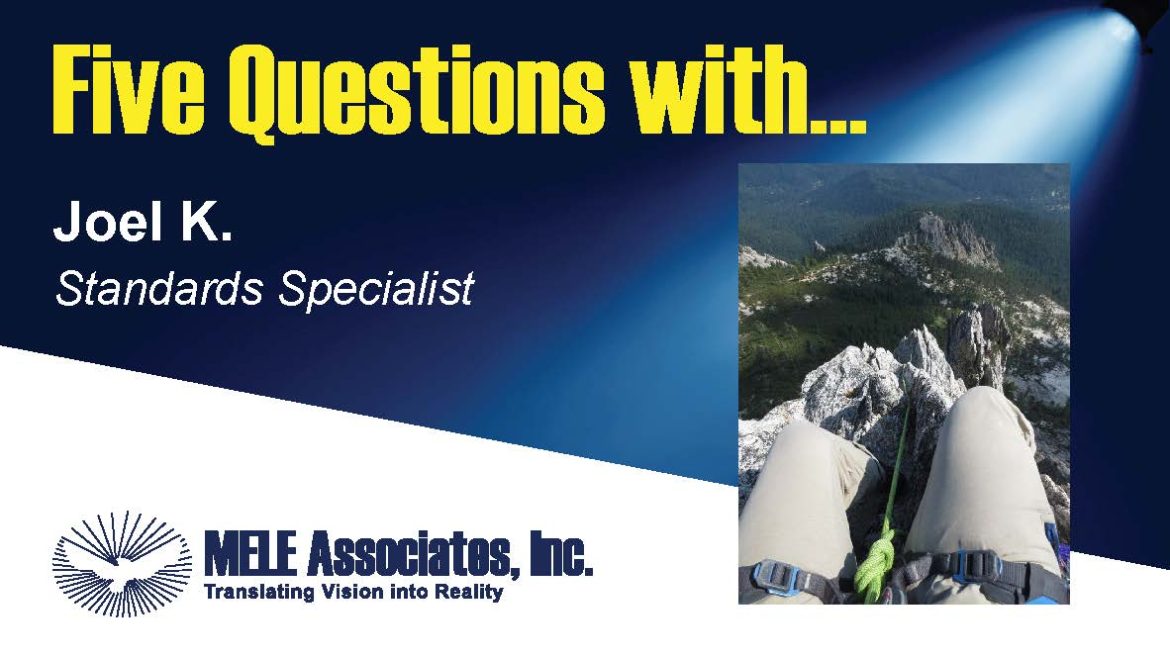
Did you know that MELE’s Joel K. is a mountain guide? Or that he leveled up his self-rescue skills after a daunting climbing experience? Read on to learn more in this installment of MELE’s Five Questions.
You were one of MELE’s earlier SkillBridge Program participants. Tell us a bit about making the transition from the military to the private sector, and how MELE and the SkillBridge program helped you transition into a new career.
MELE’s participation in the SkillBridge program helped me have a much more seamless transition from the military to private sector. I was able to move to from Virginia to New Mexico and begin working as an intern while still in the Army. When my time in the Army was up, I didn’t even have to put a new hat on. I was already familiar with what I was doing and just came into work that day the same as I had been for the previous three months.
In layman’s terms (and without touching on anything sensitive), what does a Standards Specialist do?
I actually just transitioned to the Standards & Records work center in Albuquerque. In this position, I partner with different organizations to help them conduct mission and job task analysis in order to get the enterprise into a tasked-based training model. So far, it has been great learning about different sections of the organization and the different parts of incident response they participate in.
You are currently pursuing your Bachelor of Business Administration Degree with a focus on project management at Oregon State University. What are some of the skills you learned that are helpful to your current role?
It has been a great experience learning how to interact with a totally different type of person than I have in the past. I also have really enjoyed all my business school classes and the different types of introspection and problem solving they teach. Oregon State has a terrific veteran’s resource team as well as a great online program. I have been enrolled half time in order to try and balance work, personal life, and school.
You are a passionate alpinist. How did you get into mountain climbing and what’s the sketchiest situation you’ve found yourself in while climbing and how’d you deal with it?
I’ve always been a hiker and backpacker growing up in the Pacific Northwest. “Peak bagging” was a great activity I did with my dad growing up on the weekends. While in the Army, I was introduced to confined space rescue and thought to myself that I should go ahead and learn to use these skills outdoors as well. The state of flow I reach while climbing and working on a technical route is incredibly satisfying. There is always more to learn, too.
As for sketchiest situation… Early on in my time climbing outdoors I ran into a situation where my partner got altitude sickness. While we both possessed the fitness and strength to do the climb, neither of us had the skills to “self-rescue” in an emergency.
Anyone who has ever dealt with altitude sickness knows how it can completely debilitate someone with very little warning. It got dark and very cold on the route we were on. My partner couldn’t move and we were completely unprepared to have an overnight stay in that weather. I did my best to insulate him from the rock to keep warm and initiated a call for help.
Many valuable lessons were learned that night and we were incredibly lucky everyone came out okay and no one was hurt (except our pride). We ended up getting evacuated by a National Guard helicopter. I took that as a cue to learn as much as I could to never put anyone else’s lives at risk from my activities. I have an extensive library of books on climbing rescue, rope access, and climbing philosophy/risk management.
Since then, I’ve been a member of the American Alpine Club volunteering as an instructor teaching people the basic skills to transition from indoor to outdoor climbing. I completed the Single Pitch Instructor Course with the American Mountain Guides Association as a part of that volunteer program, and had other volunteer opportunities such as helping people rappel off the 400-foot Wells Fargo building in Raleigh, NC to raise money for the Special Olympics.
Tell us about the EOD (Explosive Ordinance Disposal) Warrior Foundation and how people can get involved.
The EOD Warrior Foundation is an organization that provides specialized assistance to EOD Specialists and their families. I’ve participated and managed a couple different fundraisers for it. They will come into assist when needed. They help manage the EOD Memorial Wall at NAVSCOLEOD at Eglin AFB, provide scholarships to EOD Families, and provide monetary assistance when needed for specialty care that normal support programs may not help with.
For instance, they provided iPads to wounded EOD technicians in the hospital so they could communicate with families while still in Germany waiting to go to Walter Reed Medical Center. They also paid for all funeral expenses when one of my soldiers wives passed away unexpectedly, and they paid for family to come help take care of one of my soldiers who had issues related to a previous traumatic brain injury and had to go on an extended convalescence leave due to the amount of surgeries and ICU stays they needed to be able to get back on their feet and continue to serve.
You can get involved by visiting the EOD Warrior Foundation website Home | EOD Warrior Foundation and finding events to participate in. You can also just donate or learn more about what they provide for the EOD community.